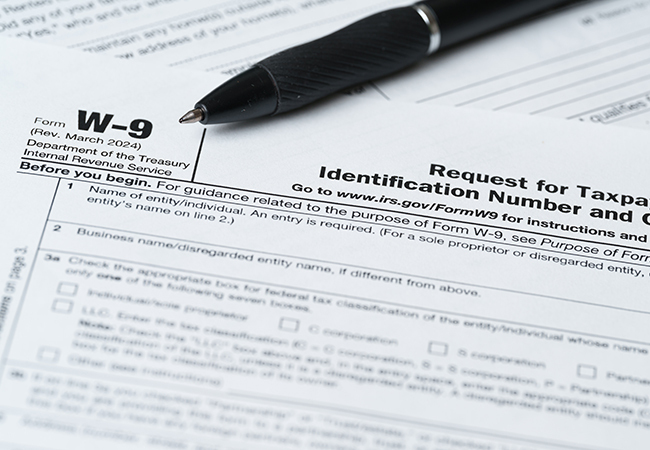
You hire an independent contractor or onboard a new vendor, and someone asks for a W-9 before payments start. What is a W-9? It’s a form the payee completes to provide their legal name, tax classification, and taxpayer identification number (TIN) so your business can report certain payments correctly.
Understanding the W-9 form matters for business owners, HR teams, and anyone who pays contractors or vendors. This tax form W-9 supports accurate 1099 reporting and helps avoid IRS issues such as TIN mismatch notices and required backup withholding. This guide explains what the form does, when to request it, and how it relates to contractor documentation and workers’ compensation audits.
Understanding What Is a W-9: The Basics Explained
The IRS Form W-9, officially titled “”Request for Taxpayer Identification Number and Certification,”” is a federal tax form used to collect a payee’s name, address, tax classification, and TIN. A W-9 is typically not filed with the IRS; the requester keeps it on file.
At its core, the W-9 form serves three primary purposes:
- Collect the payee’s Taxpayer Identification Number (TIN): This could be a Social Security Number for individuals or an EIN number (Employer Identification Number) for businesses
- Verify the payee’s legal name and business structure: Essential for accurate tax reporting forms
- Certify exemption status: Determines whether backup withholding applies to payments
The taxpayer identification number on a W-9 is used for year-end tax reporting. If you pay a nonemployee $600 or more for services in a calendar year, you generally use the W-9 information to prepare Form 1099-NEC, which reports those payments to the payee and the IRS.
Who Needs to Complete a W-9?
The W-9 requirements generally apply to payees you pay in the course of business when tax reporting may be required. Payees who commonly provide a W-9 include:
- Independent contractors and freelancers: Anyone providing services who isn’t classified as an employee
- Sole proprietors: Business owners operating under their own name or a DBA
- LLCs, partnerships, and corporations: Business entities providing goods or services
- Vendors and suppliers: Companies you purchase products or services from
- Landlords: If your business pays rent to an individual property owner
- Attorneys: Legal professionals receiving payments for services
- Financial account holders: When opening business bank accounts or investment accounts
A W-9 does not determine worker status by itself. It is tax documentation used for payment reporting and recordkeeping for tax compliance.
Breaking Down the W-9 Form: Section by Section
Understanding the W-9 instructions helps prevent delays and reduce errors that can trigger backup withholding or TIN mismatch notices. Here’s what each section of this contractor tax form is requesting:
Line 1: Name
Enter the legal name shown on the payee’s tax return. For a sole proprietor, this is the individual’s name even if they use a business name publicly. The name on Line 1 should match IRS records to reduce TIN matching issues.
Line 2: Business Name/Disregarded Entity Name
Enter a business name, trade name, or DBA if the payee uses one. This is used when the business name differs from the legal name on Line 1.
Line 3: Federal Tax Classification
This section identifies the payee’s federal tax classification, which affects reporting and withholding rules. Options include:
- Individual/sole proprietor or single-member LLC
- C Corporation
- S Corporation
- Partnership
- Trust/estate
- Limited liability company (with appropriate tax classification)
Classification helps determine how you set up the payee and which tax reporting forms may apply.
Line 4: Exemptions
Some payees may enter exemption codes for backup withholding or FATCA reporting. Many individuals and small businesses leave this blank, but certain organizations may need to provide codes as part of their taxpayer certification.
Lines 5-6: Address
Enter the mailing address where the payee wants year-end forms delivered. This address is also used for requester records and helps ensure 1099 forms are sent correctly.
Line 7: Account Numbers (Optional)
Requesters may use account numbers for internal tracking. This is optional and not required for tax compliance.
Part I: Taxpayer Identification Number (TIN)
Enter the payee’s Social Security Number or EIN number. The federal tax identification number must be accurate. If a payee does not provide a TIN, or if the IRS later notifies you the TIN is incorrect, you may be required to apply backup withholding at 24% on certain payments.
Part II: Certification
By signing, the payee certifies statements that typically include:
- The TIN provided is correct
- The payee isn’t subject to backup withholding
- The payee is a U.S. citizen or resident alien
- FATCA codes are correct (if applicable)
This W-9 certification is a legal attestation. The requester should keep the signed form in a secure file.
When Do Businesses Need to Request a W-9?
Collecting a W-9 early reduces reporting problems later. Businesses typically request this vendor information form in these situations:
Before Paying Independent Contractors
Request a W-9 when you engage an independent contractor, consultant, or freelancer, ideally before the first payment. This freelancer documentation supports 1099-NEC reporting if payments reach $600 or more for services in a calendar year.
During Vendor Onboarding
Many businesses collect W-9s during vendor registration so the payee’s legal name, address, and tax classification are on file before accounts payable starts issuing payments.
For Professional Services
Collect W-9s for payments to attorneys, accountants, and other professional service providers. Some professional payments have special reporting rules, and certain legal fees can be reportable even when other corporate vendor payments are not.
Real Estate Transactions
If your business pays rent to an individual landlord, you generally need a W-9 so you can issue Form 1099-MISC when annual payments exceed $600.
Interest and Dividend Payments
Businesses and financial institutions that pay interest or dividends typically request a W-9 to meet tax document requirements for reporting and withholding.
What Is a W-9’s Connection to Workers Compensation?
Although a W-9 is a tax withholding form, it often appears in workers’ compensation workflows because contractor payments and documentation can affect premium audits, classifications, and coverage questions.
Contractor Classification Verification
A W-9 supports the paper trail that a payee is being treated as a nonemployee for tax purposes, but it does not prove independent contractor status. Worker classification depends on the facts of the working relationship, and misclassification can create workers’ compensation audit exposure and penalties.
Misclassifying employees as independent contractors can lead to premium adjustments, penalties, and other consequences that vary by state and insurer guidelines.
Certificate of Insurance Requirements
Many businesses collect both a W-9 and a certificate of insurance when onboarding contractors. If a contractor does not carry their own workers’ compensation coverage where required, they may be treated as covered under your policy for premium and audit purposes, depending on state rules and policy terms.
Audit Preparation
Workers’ compensation audits often review contractor payments and 1099 data generated from W-9 information. Organized contractor paperwork and clear records support premium accuracy and help explain which payments should or should not be included in the audit base.
If you want an optional, quick way to sanity-check how payroll levels and job mix may affect workers’ comp exposure while you review contractor documentation, you can start here: Get an online workers’ comp estimate.
Common W-9 Mistakes and How to Avoid Them
Errors on this tax identification document can lead to payment delays, IRS notices, and year-end reporting problems. Common issues include:
TIN Mismatches
If the name and taxpayer identification number do not match IRS records, you may receive a notice requiring correction. When eligible, some businesses reduce this risk by validating payee information through IRS matching tools before issuing payments.
Missing or Incomplete Forms
A frequent gap is paying vendors before collecting a completed W-9. A common control is to require a signed W-9 certification before issuing the first payment to a contractor or vendor.
Outdated Information
Payees can change addresses, names, or tax classifications. Request an updated W-9 when you are notified of changes and consider periodic refresh practices to keep taxpayer information current.
Using Unofficial Forms
Use the current official IRS Form W-9 and instructions. Unofficial versions can omit required language or request information that should not be collected.
Improper Storage
W-9 forms contain sensitive tax identification data, including Social Security Numbers. Store forms securely, restrict access, and encrypt digital files.
Backup Withholding: What Businesses Need to Know
Backup withholding generally means withholding 24% from certain payments and remitting it to the IRS when required. It is tied to W-9 compliance because withholding can be triggered by missing or incorrect TIN information.
Backup withholding applies when:
- The contractor fails to provide a TIN
- The IRS notifies you that the TIN is incorrect
- The IRS notifies you that the contractor underreported interest or dividends
- The contractor fails to certify they’re not subject to backup withholding
To reduce backup withholding issues, request a completed W-9 before payment, keep it on file, and respond promptly to any IRS notices related to TIN mismatches.
Digital W-9 Management: Best Practices
Many businesses use digital workflows for tax document requirements management. A strong process emphasizes accuracy, security, and retention.
Electronic Collection
The IRS allows electronic W-9 collection if the process meets e-signature and authentication requirements. Digital collection can streamline vendor registration and reduce missing forms.
Secure Storage Systems
Use encrypted storage for business tax documentation, limit access to authorized staff, and keep an audit trail for downloads or edits when possible.
Retention Policies
Many businesses retain W-9s for at least four years after the last tax return that used that information. Some keep them longer because the forms remain useful for ongoing vendor relationships and tax compliance.
Integration with Accounting Systems
Integrating W-9 data into vendor profiles can reduce manual entry and improve accuracy when generating 1099s and other tax reporting forms at year-end.
W-9 vs. Other Tax Forms: Understanding the Differences
W-9s are often confused with other IRS tax forms. Key differences include:
W-9 vs. W-4
A W-4 is used by employees to set income tax withholding. A W-9 is used by nonemployees and vendors to provide a TIN and tax classification. Using the correct form affects payroll and reporting.
W-9 vs. W-8
Non-U.S. persons and entities generally complete a W-8 series form instead of a W-9. This is important for tax compliance when paying international contractors or vendors.
W-9 vs. 1099
A W-9 collects payee information. A 1099 reports payments. W-9 data is used to prepare 1099 forms at year-end.
Ensuring Compliance: A W-9 Checklist for Businesses
Use these steps to maintain consistent tax compliance:
- Create a standardized onboarding process: Include W-9 collection for all contractors and vendors
- Verify TINs: Use IRS TIN Matching before processing payments
- Set calendar reminders: Request updated forms annually
- Train your team: Ensure accounting and HR staff understand W-9 requirements
- Secure your data: Protect sensitive taxpayer information with appropriate safeguards
- Document your processes: Maintain written procedures for contractor paperwork management
- Stay current: Monitor IRS updates for changes to W-9 instructions or requirements
Conclusion: Mastering What Is a W-9 for Business Success
Understanding what is a W-9 and when to request it is a core part of tax compliance. The tax form W-9 helps you collect accurate payee information, support year-end reporting, and reduce the risk of backup withholding issues.
For business owners and HR professionals, W-9 management also supports cleaner contractor documentation, smoother 1099 preparation, and better readiness for workers’ compensation and payroll-related audits. A consistent process—collect, verify, store securely, and refresh when information changes—helps prevent common issues that surface at year-end.
If you want an optional baseline for how payroll and role mix may affect workers’ comp exposure while you tighten contractor documentation and reporting practices, you can run a quick estimate here: Run a quick workers’ comp estimate.
Ready to streamline your contractor management and ensure proper documentation across your organization? Add W-9 collection and secure storage to your contractor onboarding checklist, then review your vendor list to confirm you can generate accurate 1099s at year-end.